
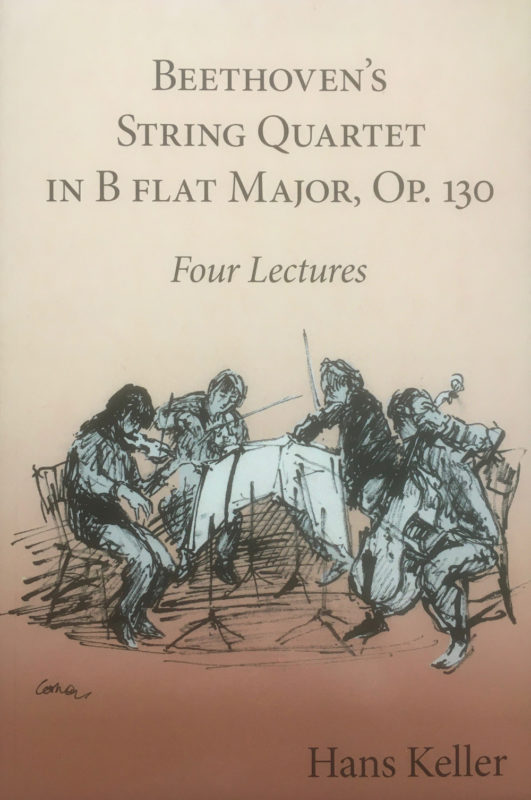
Keller was famous for his illustrated public lectures on music, and this volume publishes for the first time the full text of his celebrated 1973 series on Beethoven’s Op.130.
Keller gave these lectures at the invitation of Alexander Goehr, and they were illustrated live by the Aeolian Quartet and broadcast by the BBC. They were in part a response to Joseph Kerman’s newly published monograph on The Beethoven Quartets, and in part a demonstration of his “two-dimensional theory” of music, which posits a vital tension between “well-defined expectations” and ‘”what the composer does instead”. These lectures have now been transcribed, and appear in print here for the first time: they form Keller’s most substantial examination of a single chamber work. Keller had intended a full-length monograph on the quartet, but never got further than three chapters, of which the second, on “String-quartet Playing”, is included here along with related materials. The book comes with a supplementary volume of music examples, including the entire score of Op. 130, and is illustrated with lively string-quartet drawings by Keller’s wife, Milein Cosman.
Purchase the Book


 This volume was published for Britten’s centenary in 2013. It contains a large selection of the best of Keller’s writings on Britten, an illustrated study of Keller’s and Britten’s relationship through their correspondence (with their letters reprinted in full for the first time), a reprint of Keller’s long out-of-print handbooks on The Rape of Lucretia and Albert Herring, and an ‘Operatic Sketchbook’ of Milein Cosman’s drawings from life.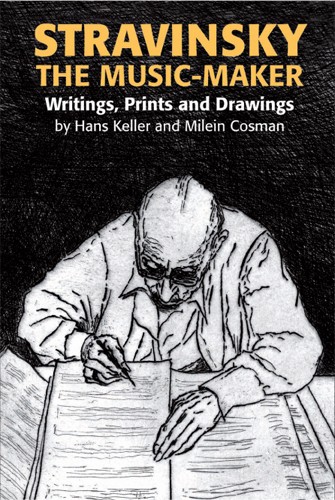
 Published in 2010, this book contains Hans Keller’s complete writings on Stravinsky, illustrated with a large selection of Milein Cosman’s drawings and prints of the composer, with a preface by Hugh Wood, setting the Keller-Cosman partnership in the framework of the British musical life they enriched.
 This book examines the effect of exile and internment on the intellectual development of the young Hans Keller, setting his personal story in the context of what is still a too-little-remembered part of British wartime history. It includes several important Keller texts, including that of his famous broadcast describing his escape from Nazi-occupied Vienna, together with his letters from British internment camps, set within the wider story of what was going on outside, where an intense political debate was taking place during Britain’s ‘finest hour’ about the rights of the individual in times of national emergency. The final section of the book shows the profound effect on Keller of his enforced change of language and culture, as he rediscovered his Viennese heritage through the very different culture of 1940s London.
 During the 1940s and 1950s, Keller was the most outspoken voice in British film music. He argued passionately for ‘the need for competent film music criticism’, laid out the main topics of the day, and studied the contribution of all the main British composers and many others besides. In particular he championed William Alwyn, Arthur Benjamin and Alan Rawsthorne as well as the more established names of Auric, Bernstein, Britten, Thomson, Vaughan Williams and Walton. In 1959 he also devoted a column to ‘television music’.


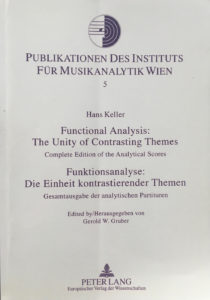 This volume contains the full scores of all Keller’s Analytical Scores, together with introduction and commentary in English and German.
 Hans Keller wrote his Jerusalem Diary in 1977 and 1979 during two visits that he and Milein Cosman made to the Mishkenot Sha’ananim, a residence for writers and artists. This Diary, which he described as an ‘anti-journal’, was initially a reaction to Saul Bellow’s To Jerusalem and Back. But the result is far more than a topical riposte: at a time of renewed turbulence in the Middle East, it is a sharp and insightful record of the artistic, social and political life of Israel at a crucial juncture in its history.

 This is a reissue of the book first published by Keller under the title 1975 : 1984 minus 9. It is a passionate defence of individualism, and a reflection on ‘the state of things we’d reached in 1975 in areas of life I know’ – music, politics, psychoanalysis and football.
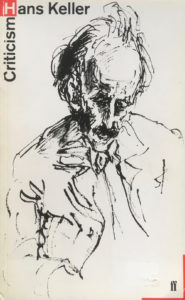 This brilliant and controversial book is Keller’s assault on ‘criticism’ and the ‘phoney professions’ of the music critic, the broadcaster, the musicologist, the conductor, the politician, the psychoanalyst, the teacher and the editor. That Keller himself was active in most of these fields at one time or another was an irony of which he was well aware.
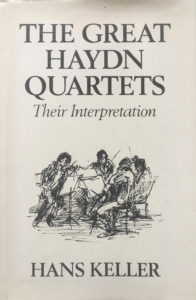 Although many composers have written string quartets, only a few have possessed an intrinsic mastery of the medium. Of these Haydn was the first and, thought Keller, in one definable sense the greatest.